
The State of Feminism
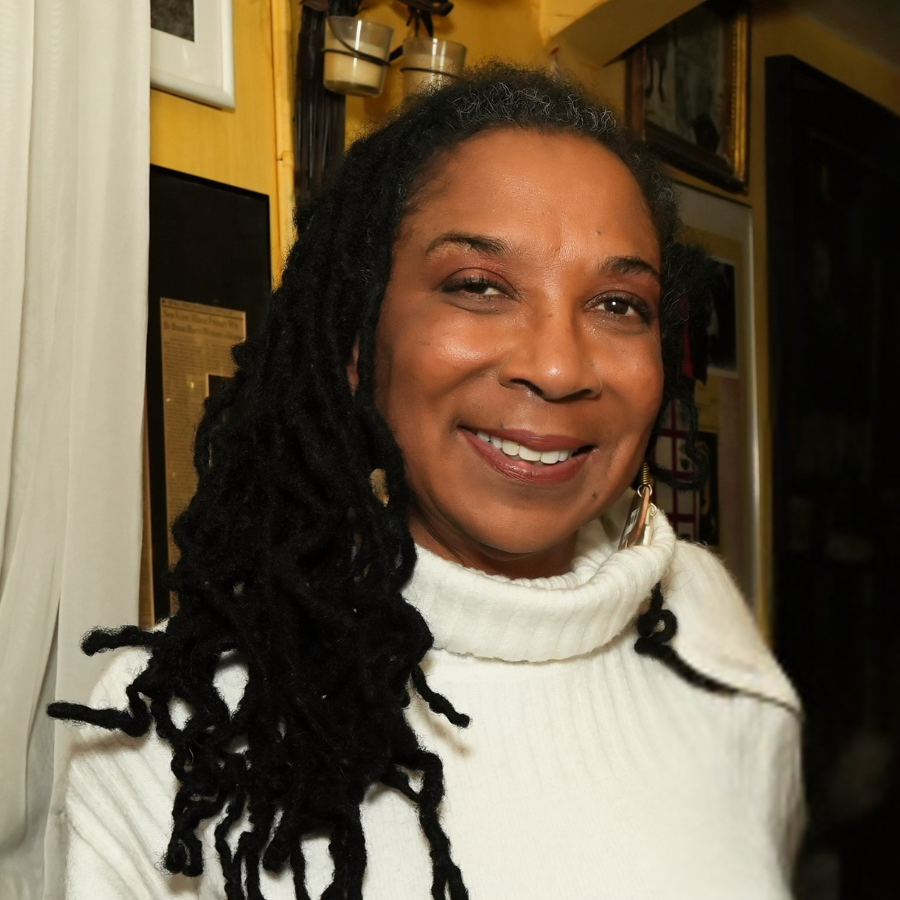
Kimberlé Crenshaw
Co-founder and executive director of the African American Policy Forum | Professor of law at UCLA Law School and Columbia Law School | Author of the new memoir Backtalker and other books
Why is it that issues, particularly around racism, have been silenced as any kind of concern whatsoever? Why is it that the absolute misogyny that we saw on display every day against Kamala Harris is not included in the analysis of how we got here? Why is it that every conversation about how we got here is about how we're not paying attention to working class men? I'm sorry, last time I checked, Black women were disproportionately working class. So make this make sense to me. Why is this not the story? The condition of Trump's possibility is the fact that he is a white man. To be president, and to be such a fricking disaster in every conceivable way, is not possible without white nationalist patriarchy. Why is that not in the news? Why do you not talk about that? It's just the background. It's the water that we swim in. It's just not legible because it's everywhere. And that is what's frustrating me because these are supposedly our allies that are telling us this stuff.
So here we are, five years after they first started attacking intersectionality, 10 years after they did crazy stuff with My Brother's Keeper, 30 years after they didn't believe a Black woman, Anita Hill. And because they didn't believe a Black woman, and because we didn't have intersectional politics, we got a Supreme Court that gave us the overturning of campaign finance reform, that gave us the collapse of the Voting Rights Act, that gave us Dobbs, that gave the attack on affirmative action. So everything that we're experiencing now is a consequence of what I call “intersectional failure.” Here we are in the middle of it.
I'm stuck because I'm writing this memoir, and I was writing about how we had this moment where we almost pulled it off. We had men of color who were proclaiming themselves to be feminists. We had feminists of color who were willing to speak out against a president that they loved dearly, but hated the fact that his racial justice framework was Moynihan 2.0. We had women of color who were willing to say later for that. And we had white women who were willing to go to the mat with us on it. We were this close to making something happen. And then the White House destroyed it. The White House reached out to people who supported us and said, “Bring it back in.” The White House just carved us up and spat us back out. We are now living the consequence of that. So if inequality doesn't have anything to do with structures and histories and just family formation and individual choices, then what's the point of feminism, what’s the point of anti-racism, what's the point of any of it? That was what our party and president got behind.
So I'm mad at them right now because we lost like 15 years of active capacity to speak back, to fight back, to understand what was at stake. And now the other side, they're the ones that are mobilized. They're the ones that have youth jumping onto their bandwagon. They're the ones that have chapters in every university. They're the ones I have to worry about when I go in my class and know somebody's taping me and eventually I'm going to be on some kind of hit list. This did not have to happen. And it happened. That's why I want to hold on to feminism.
Two years ago, there was an African American studies curriculum AP, and they had all these themes and intersectionality was one of the most important themes. DeSantis got a hold to it and said, "If you're going to teach this in Florida, it can't have intersectionality, it can't have queer theory, it can't have structural racism." The college board is a $1.5 billion institution. Rather than fight them, they gave in. They took it all off and, and added insult to injury by saying intersectionality is not a meaningful term anymore because it’s been so politicized and disrupted.
And I wanted to say, "First of all, who the hell are you to decide when a term is useful anymore?" But I share that story to say this, and this goes back to the question about feminism. Yes, we can have the values, yes, we can have analysis, but if we don't have a word that captures all of it, if we don't have something that allows us to hail each other, to know what the project is, all that energy can easily be dissipated, which is what we're seeing now. So when our young folk refuse to identify [as feminist], I realize that a number has been played on them. And that they've been robbed of our legacy and we've been robbed of what we've made possible. So I fight for feminism.
My memoir is coming out on May 5th, and I'm very torn about it because it's called Backtalker. So the theme is, you can backtalk, but it's not going to be costless; there are going to be consequences. So it is basically the story about, from the time I was five till now, the moments that I was driven to talk back. I think a lot of people think intersectionality is just a concept that just comes from the thinkers pose or something. And the point is to turn that assumption upside down and to capture every person's moment of choice about whether they will talk back or not. Anybody can theorize the world that we live in when they choose to step into their own experience and building up from that.
These remarks have been edited for clarity and length. Portions of these remarks appeared at Women’s Media Center.