
History of Feminism
A timeline of key moments, legislation, and figures
Since the very founding of America in 1776 — under a patriarchal system and a Constitution that did not include women as full citizens — feminist movements have fought for women’s equal rights, freedoms, and opportunities. Every advancement that women have made over the past nearly 250 years have been due in large part to feminist movements, which are generally categorized into waves as a helpful way to break down the historical eras.
DISCLAIMER: Although we did our best to outline the timeline of key political and cultural feminist moments in the United States, we know there are many details that we did not include here. We also understand that the information we are providing about each of these milestones only scratches the surface of their influence over the years. For more comprehensive information and context, please visit these resources from National Women’s History Alliance (NWHA), National Women’s History Museum, the American Civil Liberties Union (ACLU) National Organization of Women (NOW) here and here, Center for American Women and Politics (CAWP), and some excellent resources recommended by the Tony-winning Broadway production of Suffs. And of course, we always encourage you to be curious and find more great historical content to learn from and share.
Explore the Timeline
First Wave
(late 19th century – early 20th century)
1839
Beginning in 1839 in Mississippi, states gradually began to pass Married Women’s Property Acts, which expanded the rights of married women, allowing them to own personal property and wages, be parties to lawsuits and contracts, and execute wills on their own behalf. These acts overrode coverture laws that had prevented married women from having any legal or economic identity apart from their husbands.
1848
Led by Elizabeth Cady Stanton and Lucretia Mott, the first women’s rights convention is held in Seneca Falls, New York. The Seneca Falls Convention produced the Declaration of Sentiments that outlined the movement's agenda, which was to achieve full gender equality at all levels: economically, socially, and politically.
1866
The women’s movement splits into two organizations, the National Woman Suffrage Association (NWSA) and the American Woman Suffrage Association (AWSA).
1872
 Victoria Woodhull is the first woman to run for United States President.
1878
Sen. Aaron A. Sargent of California first introduced the Women’s Suffrage Amendment, later called the “Susan B. Anthony amendment” to Congress.
1888
The introduction of the “safety bicycle,” which grew in popularity throughout the 1890s, provides women with the autonomy to travel on their own without a chaperone, allowing them to more easily participate in social and political activities and even spurring changes in fashion. It is considered a key part of the fight for women's rights, with Susan B. Anthony famously calling the bicycle the "freedom machine."
1896
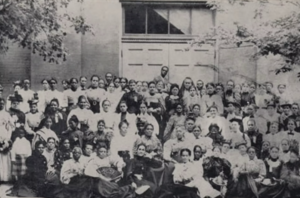
National Association of Colored Women's Clubs, Inc. organizing meeting on July 21, 1896 in Washington, D.C., Credit: NACWC
The National Association of Colored Women (NACWC), founded by Mary Church Terrell, Ida B. Wells, Josephine St. Pierre Ruffin, Harriet Tubman, and Frances Ellen Watkins Harper (among other women) is the “first national organization for African American women.” Their motto “lifting as we climb” embodies their mission to encourage Black women to support each other in the fight for social, economic, and political equality.
1916
Jeannette Rankin becomes the first woman ever elected to Congress.
1916
National Woman’s Party (NWP) forms.
1918
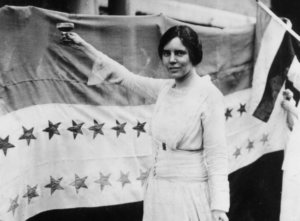
Alice Paul in 1920 Credit: Harris & Ewing, Inc.
Led by activist Alice Paul, NWP held protests outside the White House to gain attention for the amendment for women’s suffrage. It was the first time anyone had ever picketed the White House.
1920
The 19th Amendment is ratified, granting many women the right to vote (though the vast majority of Black women would not be fully granted this right for 45 more years with the passage of the Voting Rights Act of 1965). Tennessee’s ratification secured the final vote for the amendment to be included in the Constitution.
1920
The Women’s Bureau is established in the U.S. Department of Labor as a federal agency that works to safeguard the interests of working women and their families, as well as promote quality work environments.
1923
The Equal Rights Amendment (ERA) is first written by Alice Paul and Crystal Eastman and introduced into Congress in the same year. The ERA’s purpose is to guarantee full equality for all Americans, regardless of sex.
1942

The "We Can Do It!" poster, created by J. Howard Miller in 1942 for Westinghouse Electric. Credit: World Digital Library
The Rosie the Riveter campaign is launched to encourage women to join the workforce during WWII to fill the void left by men entering the military. Between 1940 and 1945, the female percentage of the U.S. workforce grew from 27% to nearly 37%. By 1945, nearly one in four married women were working outside the home.
1945
Harvard Medical School begins accepting female students.
1948
President Harry S. Truman signs The Women's Armed Services Integration Act, granting women the right to serve as permanent members of the U.S. Army, Navy, Air Force, and Marine Corps.
1950
Harvard Law School begins accepting female students.
1952
Charlotta Spears Bass becomes the first Black woman nominee for vice president in the United States, running on the Progressive Party ticket.
Second Wave
(1960s – 1980s)
1960
The Food and Drug Administration (FDA) approves the first birth control pill, Enovid, giving women reproductive freedom and greater autonomy.
1961
President John F. Kennedy established the Commission on the Status of Women in 1961, appointing Eleanor Roosevelt as chairwoman.
1963
The Equal Pay Act, signed into law by President John F. Kennedy, becomes the first federal law prohibiting employment discrimination based on sex.
1963
Betty Friedan’s The Feminine Mystique is published, sparking conversation about gender inequality nationwide.
1963
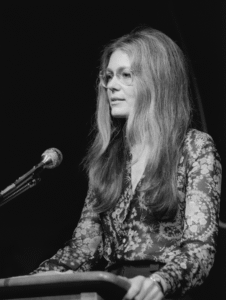
Gloria Steinem at a women's conference held at the LBJ Library.
Feminist writer Gloria Steinem goes undercover as a Playboy Bunny at Hugh Hefner's Playboy Club and writes a two-part exposé, “A Bunny’s Tale,” about it for SHOW Magazine, exposing the sexist, demeaning, and exploitative realities of working as a Playboy Bunny.
1964
Title VII of the Civil Rights Act outlaws employment discrimination based on race and sex, also creating the Equal Employment Opportunity Commission (EEOC).
1965
Senate passes the Voting Rights Act, following the Selma marches (notably bloody Sunday) that protested the blocking of the Black vote in the Jim Crow South. The Voting Rights Act ensured that no one could be denied the right to vote based on race and eliminated previous Jim Crow policies, like literacy tests and poll taxes.
1965
In the Griswold v. Connecticut decision, the Supreme Court established a constitutional right to privacy for married couples to use contraception. This landmark ruling struck down a Connecticut law that banned contraceptives, laid the groundwork for future privacy-related decisions, including Roe v. Wade, and contributed to a revolution in sexual and reproductive rights.
1966
The National Organization for Women (NOW) is founded by Betty Friedan, Rev. Pauli Murray, Shirley Chisholm, and Muriel Fox, becoming a powerful political force for liberal feminism.
1968
Shirley Chisholm becomes the first Black woman to be elected to the United States Congress. Known as “Fighting Shirley,” she introduced more than 50 pieces of legislation during her time in Congress. She was a key figure in the second-wave movement as she fought hard against gender, racial, and economic inequality.
1968
The Miss America protest takes place in Atlantic City, where women threw items including bras, girdles, high-heeled shoes, pots, pans, Playboy magazines and more into a trash can. Despite long-standing rumors that gave feminists the moniker “bra burners,” the activists never actually set fire to the trash can.
1968
President Lyndon B. Johnson signs the Fair Housing Act into law. This legislation was finally passed by Congress as Title VIII of the Civil Rights Act days after Martin Luther King, Jr.’s assassination. It banned discrimination in housing, meaning no one could be denied the opportunity to buy, rent, or finance a house based on sex, race, religion, national origin, and disability.
1969
California becomes the first state to enact the No Fault Divorce Law, following Gov. Ronald Reagan’s signing the Family Law Act. This provided a safer exit for women from abusive marriages and ensured domestic violence survivors did not have to prove abuse in court.
1969
Yale and Princeton begin accepting female students.
1970
The Women's Strike for Equality takes place nationwide on Aug. 26, the 50th anniversary of the ratification of the 19th Amendment. In New York City, 50,000 marchers walked down Fifth Avenue, arms linked, blocking traffic and symbolizing the continued fight and strength of second wave activists. The marches brought together older feminist leaders, like Betty Friedan and Bella Abzug, with a new generation, like Gloria Steinem and Dorothy Pitman Hughes.
1972
President Richard Nixon signs Title IX into law as part of the Education Amendments of 1972, which prohibits discrimination based on sex in any program that receives federal funding. As a result, Title IX opened the door for more women to take part in sports on the collegiate and professional level. It also stated that girls could not be required to wear dresses in public schools. Under Title IX, collegiate institutions are required to address all forms of sex-based harassment.
1972

The first cover of Ms. Magazine, Spring of 1972, painted by Miriam Wosk Credit: Ms. Magazine
Ms. Magazine, cofounded by Gloria Steinem, publishes its first issue, which sells out nationwide within 8 days. The publication is described as “the first national magazine to make feminist voices audible, feminist journalism tenable and a feminist worldview available to the public.”
1972
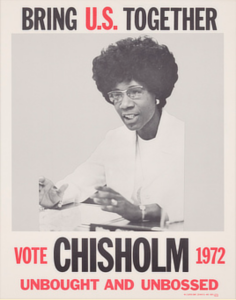
Shirley Chisholm presidential campaign poster, 1972.
Shirley Chisholm becomes the first woman to seek the nomination for President of the United States.
1973
The Supreme Court of the United States’ decision in Roe v. Wade establishes a pregnant person’s right to an abortion nationwide. Roe v. Wade was a 1970 lawsuit involving Norma McCovey, aka “Jane Roe,” and Texas District Attorney Henry Wade. McCovey was denied an abortion because her pregnancy didn’t pose a medical risk to her life. Texas lawyers Linda Coffee and Sarah Weddington filed the lawsuit on her behalf under “Jane Doe” to protect her identity. The Supreme Court ruled 7-2 in McCovey’s favor, deciding that the Due Process Clause of the U.S. Constitution’s 14th Amendment protected the right of someone to terminate their pregnancy.
1973

1973 American Tennis Champions Billy Jean King & Bobby Riggs Press Photo
Bobby Riggs challenges top-ranked female tennis player Billie Jean King to a match. Ninety million people worldwide watch the internationally televised match, dubbed “Battle of the Sexes,” as King beat Riggs in six sets in a row, as well as a $100,000 prize. Later, King said, “I thought it would set us back 50 years if I didn’t win that match. It would ruin the women’s [tennis] tour and affect all women’s self-esteem. To beat a 55-year-old guy was no thrill for me. The thrill was exposing a lot of new people to tennis.”
1974
Billie Jean King establishes the Women’s Sports foundation to advance the lives of women and girls through sports and physical activity.
1974
The Equal Credit Opportunity Act is signed into law by President Gerald Ford. The landmark legislation, sponsored in Congress by Rep. Bella Abzug, makes it unlawful for any creditor to discriminate against any applicant on the basis of sex, race, color, religion, national origin, marital status, or age. This gave women financial autonomy, allowing them to obtain a loan, mortgage, or credit card without requiring their husband’s or father’s signature.
1975
In Taylor v. Louisiana the U.S. Supreme Court ruled the systematic exclusion of women from jury panels unconstitutional, establishing that a jury must represent a "fair cross-section" of the community. This landmark decision eliminated opt-in clauses for women's jury service and reinforced the right to a representative jury for both male and female defendants.
1978
The Pregnancy Discrimination Act is signed into law by President Jimmy Carter, amending Title VII of the Civil Rights Act of 1964 to prohibit discrimination based on pregnancy, childbirth, or related medical conditions.
1978
NASA (National Aeronautics and Space Administration) begins accepting female astronauts.
1981
Bell Hooks publishes Ain’t I a Woman? Black Women and Feminism, named for Sojourner Truth’s famous 1851 speech. The book explores the feminist movement through the lens of Black women, who had been consistently ignored, dismissed, and pushed out of the feminist movements of the 20th century.
1981
Sandra Day O’Connor becomes the first woman to serve as a justice on the Supreme Court.
“I believe that it is only a matter of time before the structural barriers to women or minorities are effectively dismantled. I look forward to the day when I am thought of as the 102nd Supreme Court Justice rather than the first female Supreme Court Justice.”
–Sandra Day O’Connor from interview with Marianne Schnall
1983

[Sally Ride] America's first woman astronaut communitcates with ground controllers from the flight deck during the six day mission of the Challenger. National Aeronautics and Space Administration. Credit: The National Archives and Records Administration
Astronaut Sally Ride becomes the first American woman to go to space.
1983
Alice Walker’s book, In Search of Our Mothers’ Gardens: Womanist Prose, introduces a new variation of Black feminism called “womanism.” Womanism is closely aligned with Black feminism and many people use the two terms interchangeably.
1984
Rep. Geraldine Ferraro becomes the first woman ever to run on a major party's national ticket when she is selected by Walter F. Mondale as his Vice Presidential running mate.
1984
Women are allowed to run the Olympic marathon for the first time. American Joan Benoit wins the gold medal in Los Angeles.
1987
Lottie Shackleford is elected mayor of Little Rock, Arkansas. She is the first Black woman to be elected mayor.
1989
Scholar and theorist Kimberlé Crenshaw introduces the term “intersectionality” in her paper, "Demarginalizing the Intersection of Race and Sex: A Black Feminist Critique of Antidiscrimination Doctrine, Feminist Theory and Antiracist Politics.” This term helped bring awareness to the reality that people are often subject to multiple forms of oppression and discrimination based on their intersecting identities, including race, gender, class, and sexual orientation.
Third Wave
(1990s - 2010s)
1990
The Americans With Disabilities Act (ADA) is signed into law by George H.W. Bush. After a several-year fight, the ADA finally passed, following the Capitol Crawl, where 60 activists with disabilities crawled up the 83 steps of the United States Capitol to bring visibility to the barriers the disabled community faces in an ableist society. The ADA prohibits discrimination against people with disabilities in their everyday life — including but not limited to their workplace, public businesses, and public transportation.
1990
Dr. Antonia Novello makes history as the first woman and the first Hispanic person to serve as Surgeon General of the U.S.
1990
The Office of Research on Women's Health (ORWH) is established by National Institutes of Health (NIH) to advance the understanding of biological and social factors influencing women’s health and disease.
1991

Anita Hill testifying in front of the Senate Judiciary Committee during Clarence Thomas's Supreme Court confirmation hearing, October 11, 1991. Credit: R. Michael Jenkins
Anita Hill makes history by testifying against Supreme Court nominee Clarence Thomas, whom she said sexually harassed her while she worked for him. Despite her testimony, the Senate confirmed Thomas in a 52-48 vote, and Hill was unfortunately unprotected from condemnation and death threats for speaking out. At the same time, she heard from survivors who shared their stories with her. Her decision to speak out on the national stage continues to make survivors feel seen.
“For me, when I think about the hearing, what motivated me to do it was bigger than the consequences of doing it. I mean, I knew that I had important information about Clarence Thomas, what kind of judge he was going to be, because I knew about his own behavior that really said that he had no respect for the law and that he believed himself to be above the law…. And knowing that the law was going to be written by and shaped by someone with a disregard for it was what I was looking at. That was really what motivated me — it just outweighed the consequences. I think that there’s someplace in your conscience that says, ‘If I don’t act, then I will have been a part of something that I don’t want to live with.’ I would have been moving away from something and turning my back on something.”
—Anita Hill from interview with Marianne Schnall in What Will It Take to Make a Woman President?: Conversations about Women, Leadership and Power
1992

Top Row (L-R): Sen. Patty Murray (D-WA), Sen. Barbara Mikulski (D-MD), Sen. Barbara Boxer (D-CA) Bottom Row: Sen. Carol Moseley-Braun (D-IL), Sen. Dianne Feinstein (D-CA) 1992
This year is dubbed the “Year of the Woman” after a record number of women were elected to Congress — 24 to the United States House of Representatives and four to the Senate. This brought the total number of women in Congress to 48. This influx of women leaders was not a coincidence; many were influenced by Anita Hill’s testimony. When American women saw the number of male senators questioning Hill, they wondered where the women senators were. When Senate seats opened up, some of these same women ran to fill them — and won.
1992
Carol Moseley Braun becomes the first Black woman and the first woman of color to be elected to the U.S. Senate.
1993
Marital rape is criminalized federally nationwide by the Federal Sexual Abuse Act. While rape is considered a crime in all 50 states, there are unfortunately exemptions or loophooles in some states. For more about this, read this explainer from the National Domestic Violence Hotline.
1993
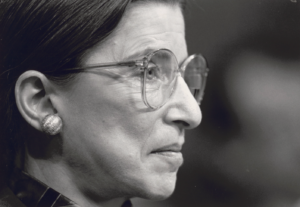
Senate Judiciary Committee - Ruth Bader Ginsburg hearing Credit: R. Michael Jenkins
Ruth Bader Ginsburg is appointed by President Bill Clinton as the second female justice ever to sit on the Supreme Court. During her long and prestigious career, Justice Ginsburg co-founded the Women’s Rights Project of the American Civil Liberties Union (ACLU) and argued six groundbreaking gender discrimination cases in front of the Supreme Court as a litigator (winning five of those six cases). As a justice, she continued her work as an advocate for gender equality, writing the majority opinion in United States v. Virginia in 1996, which ruled that qualified women could not be denied admission to Virginia Military Institute. She also famously read her dissent to the decision in the Ledbetter v. Goodyear case, in which a female employee was denied equal pay for equal work over a 19-year period. Until her death in 2020, Ginsburg was a superpower on the Supreme Court and a staunch advocate for reproductive rights and women’s rights overall.
1993
President Clinton signs the Family and Medical Leave Act (FMLA) into law. FMLA guarantees eligible employees of covered employers to take 12 weeks of leave following the birth of a child, adoption of a child, to care for a sick family member, or to care for their own serious health condition. Although the legislation is gender-neutral, it was a particular win for women, who do the majority of care work, ensuring they won’t lose their jobs or health benefits for doing so.
1993
The National Institutes of Health (NIH) Revitalization Act is signed into law to ensure that women and minorities are included in all clinical NIH-funded medical research, which has led to improving the diagnosis and treatment of conditions that affect women differently than men.
1993
Senators Barbara Mikulski and Carol Moseley Braun buck tradition by wearing pants on the Senate floor, breaking an unofficial rule that women must wear dresses or skirts.
1994
The Violence Against Women Act (VAWA) is signed into law by President Bill Clinton. In 1990, Sen. Joe Biden initiated efforts to get Congress to pass this legislation, and though it took four years, it finally passed with 226 sponsors in the House and 68 in the Senate. This final version of VAWA included the first federal criminal law against battering and provisions on rape. The bill also focused on prevention and funding for victim services. VAWA has been reauthorized four times and will be up for reauthorization again in 2028.
1994
12 Black women — Dr. Toni M. Bond Leonard, Rev. Alma Crawford, Evelyn S. Field, Terri James, Bisola Marignay, Cassandra McConnell, Cynthia Newbille, Lorretta Ross, Elizabeth Terry, ‘Able’ Mable Thomas, Winnette P. Willis, and Kim Youngblood — establish the Reproductive Justice movement. This framework of “reproductive justice” began as an effort to ensure reproductive rights be included in intersectional conversations surrounding other social justice issues that especially affect Black women and other women of color.
1995
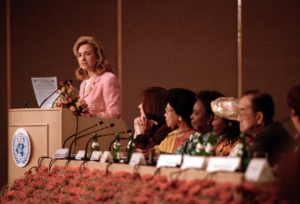
Hillary Rodham Clinton delivers the keynote address at the 4th U.N. Conference on Women in Beijing, China, September 5, 1995 Credit: Sharon Farmer
First Lady Hillary Clinton makes history with her remarks at the Fourth World Conference on Women in Beijing, where she famously said, "If there is one message that echoes forth from this conference, let it be that human rights are women's rights and women's rights are human rights, once and for all.” Her words have since gone down in history as one of the most significant rallying cries for gender equality. At the closing of the conference the representatives of 189 governments agreed on powering up a comprehensive plan to achieve gender equality: the Beijing Platform for Action. The plan outlined steps to improve the lives of women and girls from accessing education, equal pay, participation in decision-making and living a life free from violence.
1995
Feminist.com is founded in the early days of the Internet, as the first web home for a variety of important women's groups such as the Ms. Foundation for Women, Equality Now, V-Day, Girls Inc., and more.
1996
Eve Ensler, now known as V, premieres her episodic play, The Vagina Monologues, which is based on interviews V conducted with more than 200 women. The play explores “women’s sexuality and the social stigma surrounding rape and abuse, creating a new conversation about and with women.” The Vagina Monologues performances still take place across the world each year, including at hundreds of U.S. college campuses.
1996
The creation of the Women’s National Basketball Association (WNBA) is officially approved by the NBA Board of Governors. The first game takes place in 1997.
1997
Madeleine Albright becomes the first woman to be United States Secretary of State, appointed during the Clinton Administration, making her the highest-ranking woman in the U.S. government. During this time, she was a key advocate for the eastern expansion of NATO and for the withdrawal of Yugoslav forces from Kosovo.
1998
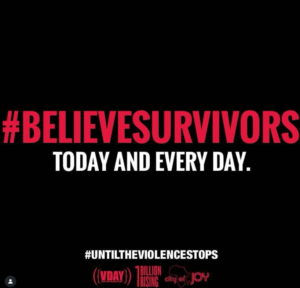
Credit: V-Day
Stemming from an idea sparked at a Feminist.com board meeting, V (formerly Eve Ensler) and a group of New York City women established the V-Day organization on Valentine’s Day 1998 to raise money for survivors and educate people about violence against women. V-Day has since raised over $150 million dollars for grassroots anti-violence groups across the globe and has expanded its mission: to end violence against all women, gender expansive people, and the Earth.
“When we started, there was no mainstream reporting on violence. It was never a front-page issue. People didn't want to hear about it. And it is now real and it's mainstream, and there is acknowledgement that this is a central issue of our times.”
– V (formerly Eve Ensler) from interview with Marianne Schnall
1999
The Women’s World Cup becomes the most successful women's sporting event in history with eighteen million viewers watching the final on television.
2000
The Food and Drug Administration approves mifepristone to be available to the American public, providing a non-surgical option for patients in need of abortion care and miscarriage management. This increased autonomy and access for patients, allowing for care in a private, at-home setting.
2005
Women’s Media Center (WMC) is founded by Gloria Steinem, Jane Fonda, and Robin Morgan. WMC is a nonprofit, nonpartisan organization with the mission to make women and girls more visible in the media.
2005
Condoleezza Rice becomes the first Black woman to serve as U.S. Secretary of State.
2006
Activist and survivor Tarana Burke starts the MeToo Movement to help sexual violence survivors, particularly women of color. Using the phrase “me too” makes survivors feel a sense of community in what can feel like an isolated experience and inspires them to share their own stories. The movement also helps build a sense of empathy for survivors, who, for decades, have often not been believed or supported when they come forward.
2007
Nancy Pelosi breaks what she calls the “marble ceiling” by becoming the first woman to be Speaker of the U.S. House of Representatives. She was elected for the position again in 2019 and served until 2023. During her time in the position, Pelosi’s crowning achievement was as a key force behind the passage of the Affordable Care Act (ACA). Throughout her career, she has remained a strong advocate for healthcare, LGBTQ+, and overall human rights, and environmental protections, among various other issues central to the Democratic Party.
2009
As his very first piece of legislation in office, President Barack Obama signs into law the Lilly Ledbetter Fair Pay Act as a direct response to the 2007 Supreme Court decision Ledbetter v. Goodyear Tire & Rubber Co. Justice Ginsburg, who had expressed her strong dissent in the Supreme Court’s decision to limit how employees could challenge unequal pay. According to a statement from the White House at the time, this legislation “amended the Civil Rights Act of 1964, so that unfair pay complaints can be filed within 180 days of a discriminatory paycheck — and that 180 days resets after each paycheck is issued.” Justice Ginsburg was a vocal champion of this legislation and proudly kept a framed copy of it in her office.
2009
Sonia Sotomayor is appointed as an associate justice of the U.S. Supreme Court by President Barack Obama, becoming the first Hispanic and third female member of the Court.
Fourth Wave
(around 2012 - present, epitomized by digital or online feminism)
2013
Three Black women organizers — Alicia Garza, Patrisse Cullors, and Opal Tometi — create #Black Lives Matter in response to the acquittal of George Zimmerman in the shooting death of Trayvon Martin. Beginning as a social media hashtag, it grew into a broader movement following the 2014 deaths of Michael Brown and Eric Garner.
2014
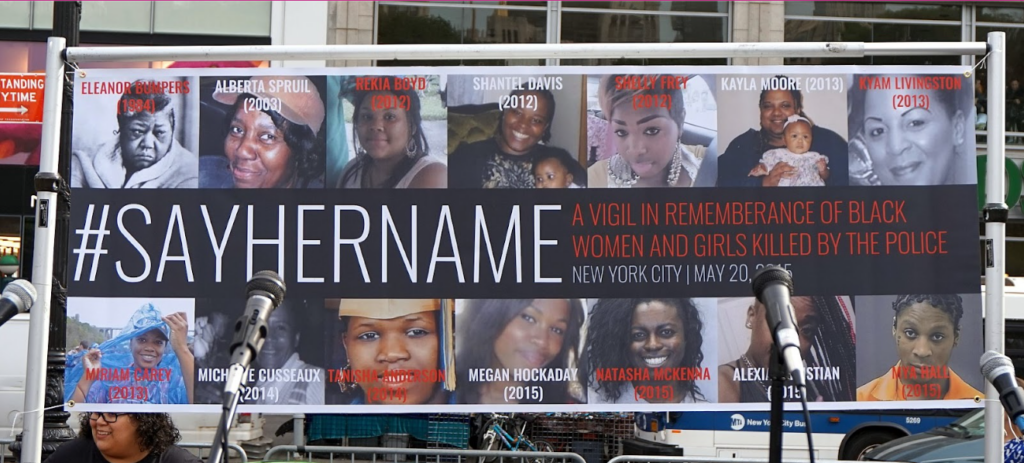
A vigil in remembrance of Black women and girls killed by the police, May 20, 2015. Credit: #SayHerName and AAPF
The #SayHerName campaign is launched to uplift stories of Black women and girls who have been killed by police and who have experienced gender-specific forms of police violence — stories that are often excluded from mainstream media. Kimberlé Crenshaw, cofounder and executive director of the African American Policy Forum (AAPF) created the movement with AAPF and the Center for Intersectionality and Social Policy Studies (CISPS).
“This is an effort to remind people that the risk that Black people face in anti-Black violence is gender inclusive. So we began to say, ‘Say her name. Choose one, and say her name.’ That became the mantra, and then that became the hashtag, and then that became the movement.”
– Kimberlé Crenshaw from interview with Marianne Schnall
2014
Beyoncé famously performs her song “Flawless” in front of a giant "FEMINIST" sign during the MTV VMAs, bringing the word to a broader, mainstream audience and sparking widespread conversation. The song features a TEDxEuston speech from Nigerian writer Chimamanda Ngozi Adichie called “We Should All Be Feminists.”
2015
In a 5-4 decision in Obergefell v. Hodges, the Supreme Court federally legalizes gay marriage. This landmark decision meant that all 50 states must recognize the legality of same-sex marriages. As of June 2025, more than 600,000 same-sex couples have been married since this decision 10 years prior.
2016
Hillary Rodham Clinton becomes the first woman to receive a presidential nomination from a major U.S. political party when she won the nomination for the Democratic party. Although Clinton lost the election, she won the popular vote with 65,844,610 million votes, 2.9 million more than her opponent Donald Trump. And the words of her concession speech remain some of the most influential ever spoken to young women and girls: “I want you to know that nothing has made me prouder than to be your champion. Now, I know, I know we have still not shattered that highest and hardest glass ceiling, but someday, someone will. And to all the little girls who are watching this, never doubt that you are valuable and powerful and deserving of every chance and opportunity in the world to pursue and achieve your own dreams.”
2017
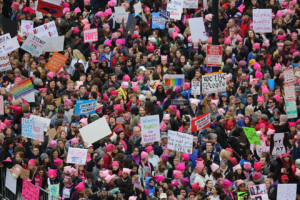
The Women's March, January 21, 2017
The Women’s March on Washington takes place. One of the largest mass protests in U.S. history, at least 500,000 people were in attendance at the D.C. March, and millions more gathered to march in other cities across the country and the world to protest the policies of Donald Trump and stand for gender and racial equality, as well as immigration rights, reproductive rights, environmental protections, and everything else the incoming administration threatened.
2017
A tweet from actress Alyssa Milano gives rise to Tarana Burke’s #MeToo movement as a response to a New York Times bombshell article exposing decades of sexual misconduct allegations against Hollywood mogul Harvey Weinstein. Soon after, many survivors came forward to tell their stories of sexual assault of powerful men — not just in the entertainment sphere but across countless other industries as well. In a Pew Research poll that year, about half of Americans polled (49%) said they supported the movement, compared to the 21% who said they were opposed, proving the power and relevancy of the call to action.
2017
For the first time in history, women entering U.S. medical schools outnumbered men.
2018
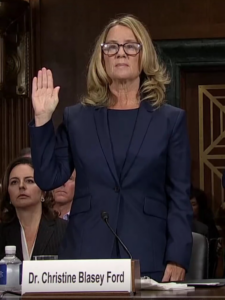
Palo Alto University professor Christine Blasey Ford rises to give an oath prior to her opening statement, September 27, 2018. Credit: United States Senate Committee on the Judiciary
In a moment that mirrors Anita Hill’s, Christine Blasey Ford testifies against Supreme Court nominee Brett Kavanaugh at his confirmation hearing. In her testimony, Blasey Ford detailed her account of Kavanaugh sexually assaulting her at a college party. During this time, Blasey Ford and her family faced death threats that forced her and her family to seek security protection and stay in hotels. Although Kavanaugh was confirmed by the Senate with a vote of 50-48, Blasey Ford’s decision to speak up galvanized survivors all over the country to tell their own stories and bring visibility to sexual violence across the U.S. and world.
2018
Sharice Davids and Deb Haaland become the first Native American women elected to Congress.
2018
Ilhan Omar and Rashida Tlaib become the first Muslim women elected to Congress.
2019
A record six women formally announce their candidacy for president: Rep. Tulsi Gabbard, Senator Kirsten Gillibrand, Senator Kamala Harris, Senator Amy Klobuchar, Senator Elizabeth Warren, and Marianne Williamson. This is the first time in history that more than two women competed in the same major party's presidential primary process.
2019
The Fairness for Breastfeeding Mothers Act is passed, requiring public buildings to provide a lactation room for public use.
2020
Virginia becomes the 38th state to ratify the Equal Rights Amendment (ERA), giving it the exact number of states needed in order for the amendment to become part of the Constitution. The ERA has still not been ratified as part of the Constitution because of a ratification deadline Congress set for 1982 that has not been lifted.
2021
Kamala Harris is sworn in as the first woman, the first African American, and the first South Asian American to be Vice President of the United States.
2022
By siding with the state of Mississippi in Dobbs v. Jackson Women’s Health Organization, the Supreme Court overturns the precedent set by Roe v. Wade and sends abortion back to the states, leading to bans in 41 states, with full bans in 12 states. While this is a huge loss for women and pregnant people across the country, the decision spurred on voters across the country to vote to protect abortion where they live. In 2024, seven states voted to protect abortion rights in their state, with Missouri overturning their previous ban.
2022
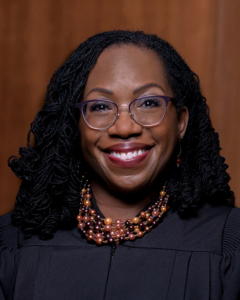
Justice Ketanji Brown Jackson, Credit: Fred Schilling / United States Supreme Court
Ketanji Brown Jackson is appointed as an associate justice of the U.S. Supreme Court by President Joe Biden, becoming the first Black woman and sixth female member of the Court.
2022
Congress passes the Pregnant Workers Fairness Act (PWFA) and the Providing Urgent Maternal Protections for Nursing Mothers Act (PUMP Act), requiring employers to provide pregnant and postpartum workers with the right to reasonable accommodation at work, including access to basic accommodations, such as bathroom breaks or leave for healthcare appointments, as well as provide all breastfeeding employees with reasonable break time to pump and a private lactation space that is not a bathroom.
2024
Kamala Harris becomes the first Black and South Asian woman presidential nominee.
2025
The United Nations celebrated 30 years since the Beijing Declaration on Human Rights, recognizing that 1,583 laws addressing gender-based violence have been enacted in 193 countries (as opposed to 12 in 1995). In addition, governments from 189 countries declared gender equality a matter of human rights.
2026 and beyond
Together we are still making feminist history. We can all be a part of shaping a more inclusive, equitable world.
To dive deeper into the history of feminism—and watch and listen to clips from some of the most influential feminists of our time—check out this special episode of the ShiftMakers podcast, hosted by Feminist.com founder Marianne Schnall. She draws from her rich archive of interviews with leaders like Gloria Steinem, Anita Hill, Kimberlé Crenshaw, Jane Fonda, and many others to frame a journey through the past and present of feminism—highlighting defining cultural moments, the movement’s ongoing evolution, and addressing common misconceptions about what feminism really means. Created in partnership with Feminist.com